

A modern rendering of Scrooge in which every offering is evaluated.
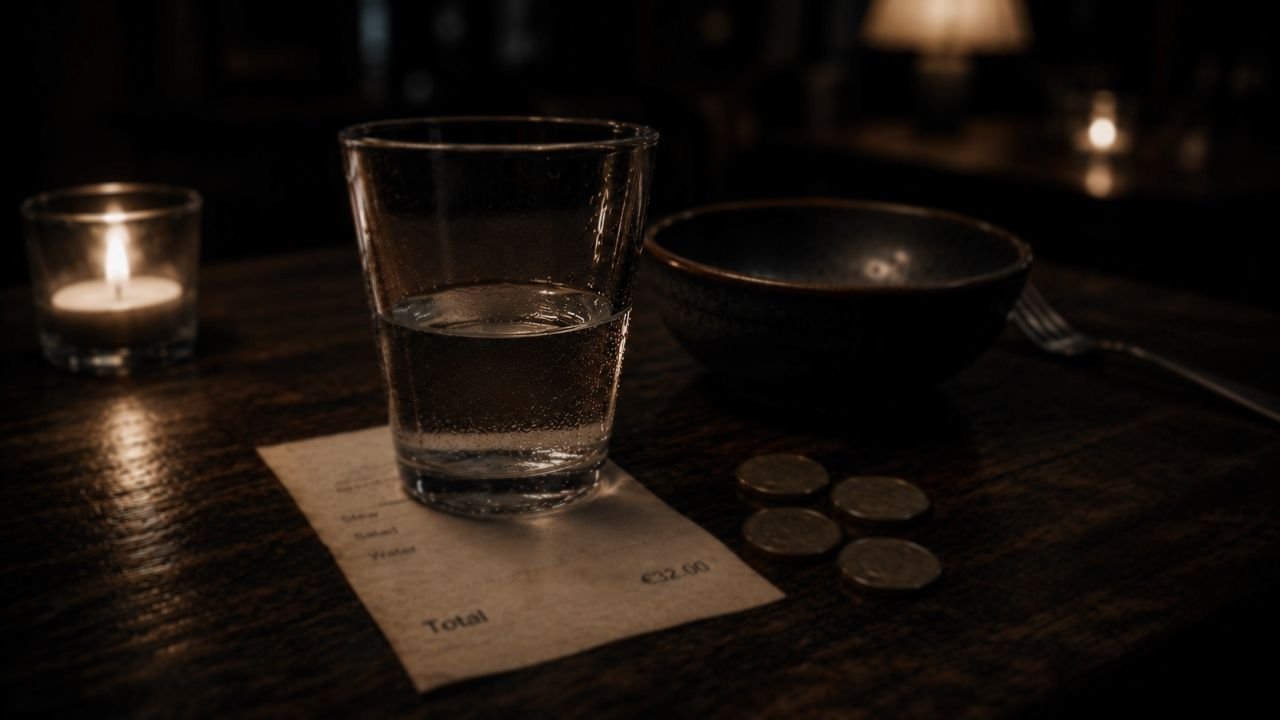
The ceramic bowl is too shallow to retain heat in this air-conditioned draft.
The receipt is tucked under the edge of my water glass. It is printed on 55gsm thermal paper, slightly curled at the corners. I have three others in my breast pocket, folded by city, by date, by weight of the primary protein.
Rotterdam: 120g, excessive root vegetables, 26 euros.
Hamburg: 140g, over-salted, 22 euros.
Lyon: 155g, lukewarm, 19 euros.
I lift the spoon. The surface of the stew has developed a thin, translucent skin. It resists the silver edge for a fraction of a second before breaking. I press the pad of my thumb against the edge of the table. The wood is cold, polished with a wax that smells faintly of synthetic citrus.
The weight of the spoon is wrong. It is balanced for aesthetics, not for the efficient transport of liquid. Too much handle, too little bowl. I look at the window. The glass reflects the bistro’s interior — brass rails, Edison bulbs, a waiter adjusting a stack of linen napkins. Beyond the reflection, there is a street. Cobblestones. People are moving between the pools of yellow light cast by the shops.
I do not look at them. I look at the beef.
I use the tines of the fork to separate a cube of meat from the gravy. It is approximately 2.5 centimetres on each side. I press it. It is firm. I consult my notes. In Barcelona, the cubes were irregular, leading to uneven cooking times. Here, the uniformity suggests a mechanical slicer. The cost-per-unit is 12% higher than the seasonal average for this district.
The citrus wax smell is sharp. I press my thumb harder against the table edge. The pressure creates a pale indentation in the skin.
A couple at the next table is laughing. The sound is a series of high, percussive bursts. I check the time on my watch. 19:42. I have been here for fourteen minutes. The stew has dropped approximately eight degrees since it was placed on the marble runner.
I take a bite. The texture is fibrous. I count the chews. Eighteen. Nineteen.
I pull a small, black ledger from my coat. I record the temperature of the room. It is too high for the price of the wine list, yet the draft from the door remains constant. I feel the air hit my ankles every time the heavy oak door swings open.
I picture the columns — red ink, black ink, the narrow margins where the profit disappears into “ambience” and “service fees.”
I move a piece of carrot to the side of the bowl. It is cut into a perfect hexagon. Waste. To achieve a hexagon from a cylindrical root requires the removal of six curved segments. I calculate the percentage removed. 30%. They are charging me for the carrot they threw in the bin.
The table edge is a hard, unyielding line against my thumb.
I stand up. I do not finish the stew. The liquid temperature has flattened. I signal the waiter. He approaches at a pace meant to appear faster than it is.
“The cheque,” I say.
“Was everything to your satisfaction, sir?”
I look at the hexagonal carrot. I look at the receipt under my water glass. I feel the pressure in my thumb.
“It was as expected,” I say.
I reach into my pocket and pull out a clip of bills. I select the exact amount. No rounding. I place the notes on the table, aligned with the edge of the placemat. The draft from the door hits my neck.
Outside, the cobblestones are wet. I step onto the pavement. The air is sharper here, but it doesn’t cost anything. I walk ten paces, then stop. I reach into my pocket and touch the corner of the ledger.
I turn back and look through the glass. The waiter is clearing my table. He picks up the bowl. He doesn’t notice the carrot. He doesn’t notice the temperature of the ceramic. He dumps the remaining contents into a plastic tub.
I walk toward the corner. My pace is measured. Four kilometres per hour. Efficient.
The pressure in my thumb remains. I press it against the handle of my umbrella as I walk. I see another bistro three blocks down. The awning is green. The menu is posted in a brass frame.
I stop. I look at the menu.
The menu lists stew. The price is 24 euros. I stay on the footpath, the cold air moving through my coat, watching the waiter inside the new bistro polish a glass. I do not move towards the door. I do not move away. I stand in the light of the green awning, my thumb pressing hard against the curved wood of the umbrella handle.