

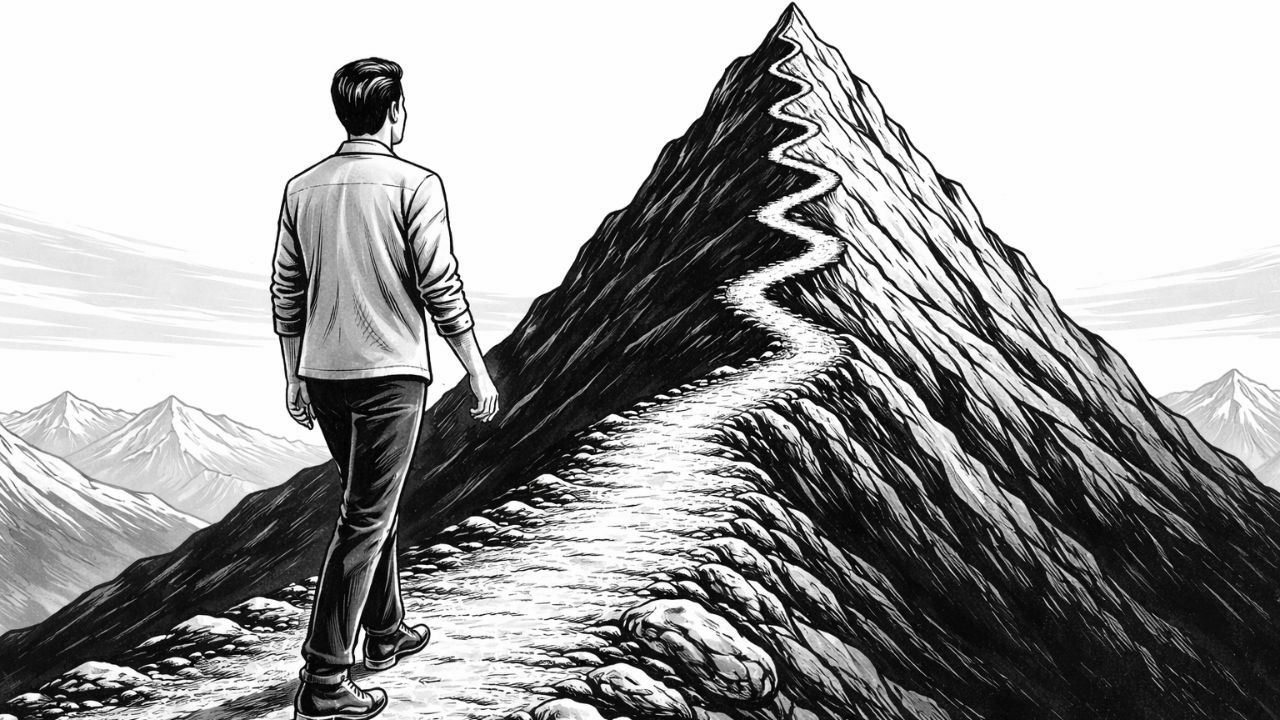
The Orientation
I am not here to tell a story of grit, nor am I offering a way off the mountain. I have heard other ways of telling this—that I must be imagined happy, or that I should find joy in the futility. This is not one of them.
This is a record of a recurring tension. It is an account of the clash between the self and the magnetic pull of external validation. For ages, I have been a prisoner not of the stone, but of the need for a finish line—driven by the agonising hope that if I push hard enough, the universe might finally give me an ending and tell me I am “done.” I find myself trying to solve a circle by treating it like a ladder.
The exhaustion does not only come from the stone; it comes from the noise of that haggling—the persistent need for the mountain to justify the effort. This is a noticing of that noise, a brief refusal to let the judge speak, and a return to the push.
The Memory of the Chain
I remember the cold bite of the bronze when I snapped the locks on Death’s wrists. I was a King then, and I believed I could sharpen the world into a straight line. I thought if I could chain Death in my cellar, I could keep the sun from setting on my house. I wanted a life that was all feast and no hunger.
I thought I was cheating the Inevitable Ebb—the natural pull of the tide. But in stopping the end, I accidentally choked the beginning. Without the descent, the air went stagnant. I traded the rhythm of a living man for the stillness of a statue. I called it a victory then; now, I see it as a freezing.
At the Base
Now, I am back at the roots of the mountain, and the stone remains the only answer. My mind is often a crowded marketplace: If I shift my grip, will the slope soften? Why must I endure this if it doesn’t transform me into something more?
I remain a merchant of “if,” haggling with gravity. Seeking a “why” is a constant temptation—a way of borrowing energy from a future that may never arrive. The world insists that I need a “Why” to find a spark, but a “Why” often feels like a ghost-witness—a merchant’s trick used to make the pressure feel like a down-payment on a better life.
I find myself trying to pay for today’s climb with the promise of tomorrow’s “Meaning,” and when the stone rolls back, I am left in the same spiritual debt. I am not just tired; I am busy—exhausted by the labour of pretending the Ebb can be negotiated away.
The Dante Pivot
The pivot does not come from a god’s mercy; it is a movement born of the weight itself. There is a point, when the incline is at its cruellest, where the pressure reaches a crushing centre. I recall the man who found his way through the abyss by climbing down the shaggy flank of the world’s heart. At the point of maximum weight, he didn’t pull back.
He rotated. He turned his body until “down” became “up.”
In the moments of greatest pressure, I attempt something similar. For aeons, I have been looking Up. Up is where the validation lives; it is where the summit promises a “well done” and an end to the labour. Looking Up keeps the merchant alive, always measuring how much of the mountain is left. It is a state of perpetual debt.
Under the weight, I rotate my gaze. I turn my attention from the summit to the Contact. I look at the exact millimetre where my palm meets the rough skin of the stone. At the centre of the pressure, there is a temporary reorientation. I am still under the mountain, but I am momentarily present within the pressure rather than distracted by the distance.
The gravity of the mountain remains. The pull of the summit—the desire for the saviour at the peak—is still magnetic, still plausible, still there. But for a breath, the attention is on the centre of the pressure. I am not escaping the circle; I am noticing how it feels to stand inside it.
I still aim for the crest. I still place my feet with the intention of reaching the top. The summit remains the coordinate that gives the effort a shape; it is the reason for the tension. But in the rotation, it is no longer the sole judge.
The Crest
When I reach the crest, the old pattern waits. I feel the urge to brace, to scream against the return. Then, I let go. I watch the stone gather speed, carving its path back through the dust. My heart still threatens to tumble down the slope with it, bruised by the return.
The sight of the stone retreating offers an easing, like a bowstring released. There is a tiredness in the muscles. Meaning remains a flickering ghost, and in its absence, there is only the raw, cold contact of the rock against the palms. This is not a solution, nor a new system of belief. The gravity remains.
The stone is at the bottom because that is where stones go; I am at the top because that is where the push ended. The mountain is still the mountain.
The Descent
I begin the walk back down. The air is cool, and my hands are empty. I see the stone waiting in the tall grass—a silent, heavy shadow. It is a task to be repeated, a recurring strain of a mind that thinks and a body that works. To have this weight to return to is not a victory, but it is the evidence of a pulse.
I reach the bottom. I place my hands against the cold, rough skin of the stone. The old ghost is there, looking past the rock toward some imaginary horizon, asking, “What now?”
The summit is visible, promising an end that never stays. The contact is felt, offering a pressure that never leaves. I take a breath, my hands still upon the stone, the mountain intact before me.