

If tensions in our lives are signalling that something is not quite right, shouldn’t we look for ways to resolve them?
This is a serious objection.
Pain often signals physical injury. Dissatisfaction can reveal a situation that cannot continue. Resentment can expose a boundary that has been repeatedly crossed. If tension operates like a signpost pointing to a problem, then remaining with tension might be nothing more than tolerating something that ought to change. To treat tension as something to be observed could be a form of neglect.
But the objection assumes something: we already know what the presence of tension tells us.
There are at least three possibilities worth considering.
• Tension may come from something beneath it.
• Tension may be one lens among many.
• Tension may come first.
Each places tension differently in relation to experience.
The difference becomes clearer on a tightrope.
The Walker
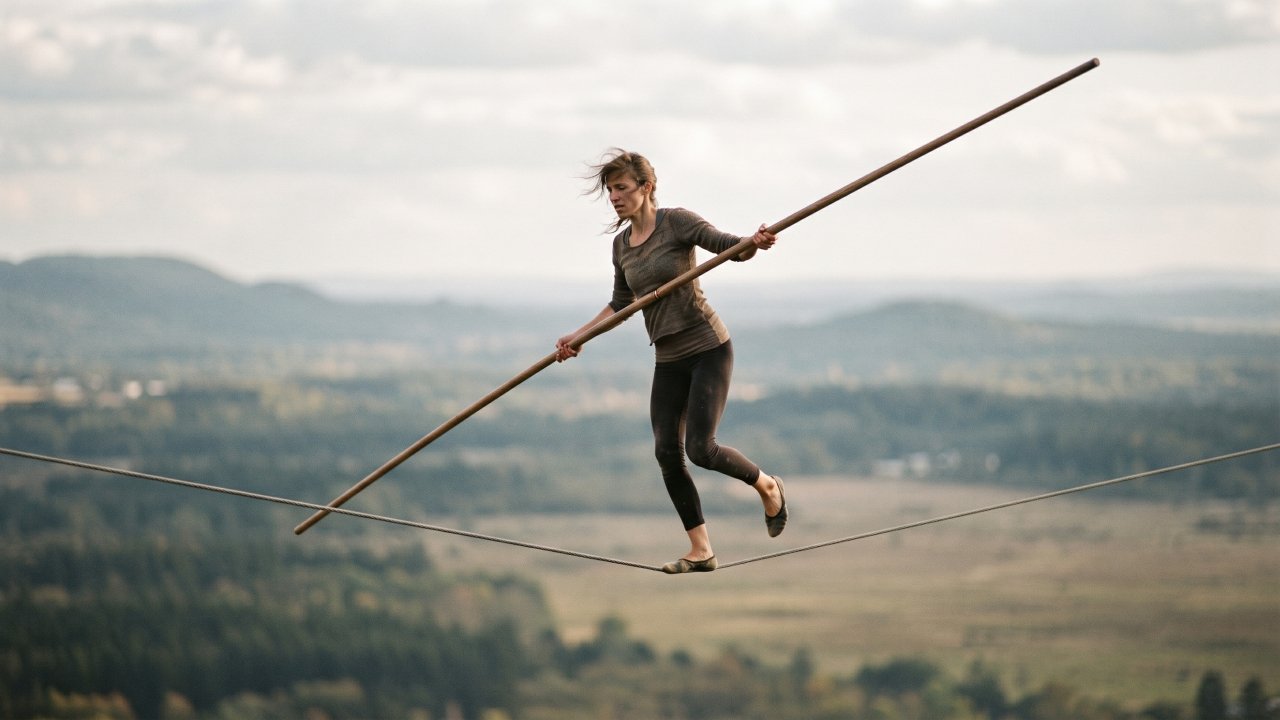
Consider a tightrope walker carrying a long balancing pole.
The rope moves under their feet.
Their body shifts.
The pole tilts.
Weight moves from side to side.
The walker adjusts.
There is tension throughout the scene.
What does that tension mean?
Tension Comes From Something Beneath It
Perhaps the walker feels an unusual pull. The wind may have strengthened. The rope may have loosened. Their footing may be placed incorrectly.
Here, the tension may point to something in the situation. If the rope is failing, the walker may need to adjust their stance, stop, or step off the rope altogether.
Here, the objection may be right: something may indeed not be quite right.
Tension Is One Lens Among Many
Keep the physical event the same.
The rope moves. The pole shifts. The body responds.
We describe this as tension. But the same sequence of events could be described as balance, movement, coordination, adjustment, or attention.
Perhaps “tension” is not always a separate thing sitting inside an experience, waiting to be removed. It may sometimes be one way of making sense of what is happening.
The event may remain the same while how we understand it changes.
One person may see danger. Another may see courage. Someone else may see recklessness. The walker may understand the movement simply as adjustment.
These different perspectives do not make the situation whatever we want it to be. The rope may still be sound. It may still be failing.
What is there and how we understand what is there are not necessarily the same thing.
Tension Comes First
Look closer at the rope itself.
There was no stable, tension-free state of balance to begin with. Gravity is already pulling. The rope is already resisting. The balancing pole distributes weight in opposing directions. The body continually corrects.
Balance may be a temporary shape tension takes.
Removing every opposing force would not perfect tightrope walking. It would remove the conditions through which tightrope walking occurs.
Some tension may not be a disturbance of the condition, but part of the condition itself.
What the Walker Carries
Up to this point, it is easy to treat the walker as if they were merely receiving signals from the rope. But the walker never arrives empty.
They arrive carrying something.
Perhaps they have walked this rope many times. They carry experience. Perhaps they fell yesterday. They carry fear. They carry a desire to reach the far platform. They carry expectations about what stability ought to feel like. They may believe that a good walker should never wobble.
What the walker carries shapes how they encounter the situation.
It may also shape what they expect to happen. Fear may anticipate a fall. Confidence may anticipate reaching the other side. What is expected can give the movement a shape before its outcome is known.
Fear, for example, may change how an ordinary shift of the rope is encountered. The body tightens. The tightening affects the pole. The pole’s changed movement then seems to confirm that the situation was dangerous all along.
This gives the second possibility greater force. What is carried does not merely alter the words used to describe an event after it happens; it shapes how the situation is encountered as it unfolds.
Yet this does not mean the situation comes entirely from the walker. The rope may still be loose. The wind may genuinely have picked up. A walker can be frightened and the rope can be unsafe.
What the walker carries shapes how the situation is encountered and what may be expected from it, without determining what the situation must be or how it will unfold.
What Does Tension Tell Us?
These possibilities leave the question open. More than one may be present in the same situation:
• It may indicate something in the situation.
• It may depend partly on how the situation is encountered.
• It may belong to the activity itself.
Some tensions arise in situations that can change: a harmful job, an unsafe place, a conflict that can be addressed. Changing the situation may lessen or remove the tension.
Some tensions may also depend partly on how a situation is encountered. A difficult conversation may feel threatening to one person and necessary to another. What each brings to it may shape that encounter, without deciding what is actually happening.
Other tensions arise around conditions that cannot be removed from life, such as mortality or uncertainty. The conditions themselves may remain, though how they are encountered and lived may change.
Perhaps most tensions do signal something that is not quite right. Perhaps they do not. These possibilities cannot tell us how often each occurs.
The presence of tension alone does not tell us what the tension means.
We might begin by assuming that tension probably signals something wrong, then look for a way to resolve it. Or we might begin by assuming that tension belongs to life, then learn to endure it.
Either orientation may turn out to fit the situation. But each begins with an expectation of what the tension means and where the encounter should lead.
There is another possibility: ask what is happening here. Resolution may follow. Endurance may follow. Adjustment may follow. Something else may follow. None is required in advance.
Contact Without Demand
The walker need not settle what tension ultimately is before making their next move. They meet the rope, the wind, the pole, their body, their fear, their confidence, and their expectations. Fear, confidence, and expectation may each shape how the walker encounters what is happening.
Contact with what is happening does not require seeing without a lens. What is encountered may confirm, resist, or change what was expected.
Asking “What is happening here?” does not require stopping to arrive at an answer before acting. Sometimes the situation is met in the movement itself.
Sometimes the adjustments become smooth, almost effortless, taking on the quality of flow. At other times, every movement requires deliberate attention. Contact is not defined by either state.
Leaving the Rope
Consider a situation where the rope genuinely is failing. The walker steps off. The tension decreases or disappears.
Presence did not require preserving that tension. In this situation, contact meant getting off the rope.
Now reverse the scenario. Suppose the rope is entirely sound, but the walker demands that every wobble and every sensation of instability disappear before they take another step. Tightrope walking cannot be free of those things.
There is a difference between changing a situation that can change and requiring tension to disappear before continuing.
The Question Before the Answer
Tensions in our lives may indeed be signalling that something is not quite right.
Some tensions may reveal conditions requiring change. Others may belong to conditions through which something is possible. Others may appear differently according to how a situation is encountered. What we carry may shape that encounter.
The question is not whether tension should always be resolved. Sometimes resolution may fit the situation.
Nor is the question whether tension should simply be endured. Sometimes endurance may fit the situation.
The question is what happens when resolution, endurance, or any other outcome is decided in advance. In such a situation, what is encountered may be made to fit what was already expected.
But “What is happening here?” does not provide the answer either.
It keeps the answer open to what is encountered.
Return to the Walker
The rope moves. The pole shifts. The body responds.
The walker stands on the rope, carrying fear, memory, expectation, and a destination. The wind moves around them. From where they stand, what is carried and what is encountered cannot always be neatly separated.
Perhaps something is wrong. Perhaps nothing is wrong.
Perhaps what is happening does not fit neatly into “wrong” and “not wrong”.
The next movement may be forward, backwards, or off the rope entirely. But that movement cannot be determined simply from the fact that tension is present.
Does tension mean something is wrong?